



Pest Control & Wildlife Removal in China, Maine

China, Maine sits in Kennebec County around China Lake, a roughly 3,939-acre, two-basin lake that gives the town its name and its character. The eastern basin, entirely within China, has a shoreline mixed with year-round homes and seasonal cottages, while the deeper western basin stays largely undeveloped because it serves as a protected drinking-water source for Waterville and Winslow. Add two more water bodies, Threemile Pond and Branch Pond, and China is a town where roughly 12% of the land area is water, wrapped in the kind of wooded shoreline that defines pest and wildlife pressure here. Wildlife Chief, licensed and based near Athens in Somerset County, serves China as an extended part of our Kennebec County coverage - it's roughly 40 miles and about an hour's drive southeast of our home base, farther than our closer stops in Skowhegan and Waterville, but well within the territory we cover for Kennebec County property owners.

Request a Callback

Fill out the form below and we will call you back to talk about your project.
Wildlife Chief technician spraying a wooded yard edge for ticks and mosquitoes

That lake-and-woods geography is exactly the setting where pest and wildlife problems concentrate. Entomologists who study tick habitat have found that tick density peaks right at the edge where a mowed lakefront lawn meets untouched woods - the leaf litter and shaded ground cover there hold the humidity ticks need to survive, and that same understory shelters the small mammals ticks depend on as hosts. China Lake's shoreline, with its mix of maintained camps backing onto wooded, undeveloped land (especially around the protected west basin), has no shortage of that edge habitat. Mosquitoes follow the same pattern: standing water is all they need to complete their life cycle, and shoreline vegetation and debris along a lake like China's can either suppress mosquito breeding, when cleared and managed, or support it, when left alone.

Wildlife entry follows the buildings themselves. Maine's Inland Fisheries & Wildlife agency is direct about this: older buildings offer far more points of entry for bats than modern construction, and shake or cedar shingle roofs without underlayment are a particular risk. The agency names chimneys and masonry joints, gaps where window frames meet siding, building corners, and places where pipes or wires pass through attic walls as the usual entry points - and it specifically calls out camps, not just year-round homes, as a structure type where bats turn up in Maine. China's mix of older village-era homes around China Village and South China alongside seasonal lake cottages fits that profile closely. Rodents work the same way, finding their way in through gaps as small as a dime and settling into structures that sit unchecked between visits - a bigger risk for a camp that's closed up for months than for a house someone walks through every day.

Wildlife Chief technician treating the exterior wall of a building

Wildlife Chief handles the full range of problems that come with this kind of property in China: general pest control for the ants, spiders, and seasonal invaders that show up in both year-round homes and lake camps; wildlife removal for raccoons, squirrels, and other animals that find their way into attics, crawlspaces, and outbuildings near the water; bat removal and exclusion, following Maine's seasonal timing requirements so bats are sealed out without being sealed in; rodent control for mice and other rodents working their way into structures through foundation gaps and roofline entry points; tick treatment for lawns and yard perimeters, aimed at the wooded edges where tick populations concentrate; and wasp and hornet removal for nests that build up in eaves, docks, boathouses, and woodpiles over a Maine summer. Owner Jesse Huff holds Maine Commercial Master Applicator licensing in categories 7A (Structural General Pest Control) and 7E (Biting Fly & Other Arthropod Vectors), covering the structural pest and tick/mosquito work China properties need most.

Statewide, Maine has seen a real increase in tickborne disease activity in recent years, with Lyme disease case counts climbing each season, and mosquito-borne virus risk has been elevated across the state as well. China and the rest of Kennebec County sit within that broader Maine pattern of rising tick and mosquito pressure, even where county-specific numbers aren't published. For camp owners reopening a cottage for the season or year-round residents dealing with an active bat or rodent problem, the point isn't the statistic - it's that lake country creates the habitat, and that habitat needs to be managed.

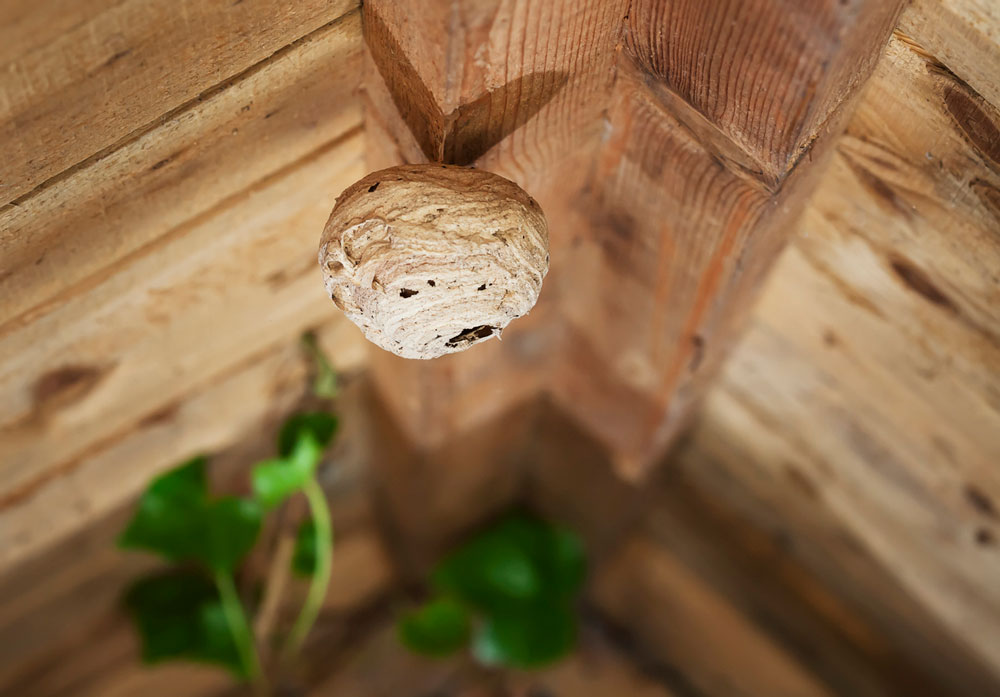
Paper wasp nest built under the wooden eaves of a structure

Frequently Asked Questions - China, ME

Do you service China, ME, or is it outside your normal range?

Yes, we service China. It's roughly 40 miles and about an hour's drive from our base near Athens, which puts it at the edge of our Kennebec County coverage, but we regularly work properties in this part of the county.

We have a seasonal camp on China Lake that sits closed for months at a time. Is that a bigger risk for pests or wildlife getting in?

Closed-up structures are harder to catch problems in early simply because no one's there to notice them. Maine wildlife officials note that older buildings and camp-style construction, particularly shake or cedar shingle roofs without underlayment, offer more entry points than modern housing. A pre-season inspection before you reopen for the year is the most effective way to catch an issue before it's established.

We found a bat in our camp. What should we do?

Don't handle it directly. If there's been any contact with a person or pet, Maine guidance calls for the bat to be tested for rabies, so don't release or dispose of it yourself - contact us and we'll walk you through next steps, then handle proper exclusion so bats can't get back in.

Our property backs up to woods near the lake. Why do we seem to get more ticks than friends who live in town?

The edge where a mowed lawn meets untouched woods is the exact habitat ticks favor - the leaf litter there holds humidity and shelters the small mammals ticks use as hosts. Lakefront and wooded properties around China Lake tend to have more of that edge habitat than a cleared in-town lot, which is why treatment focused on yard perimeters and wooded borders makes a real difference.

Do you handle wasp nests around docks and boathouses, not just the house itself?

Yes. Docks, boathouses, eaves, and woodpiles are common nesting spots around lake properties, and we treat those structures along with the main residence.

Send Me a Message

"*" indicates required fields

Don’t wait!

Reach Out To Me

Do you have a wildlife or pest problem? Don’t wait! Contact me today for fast, reliable wildlife removal services in China, ME.